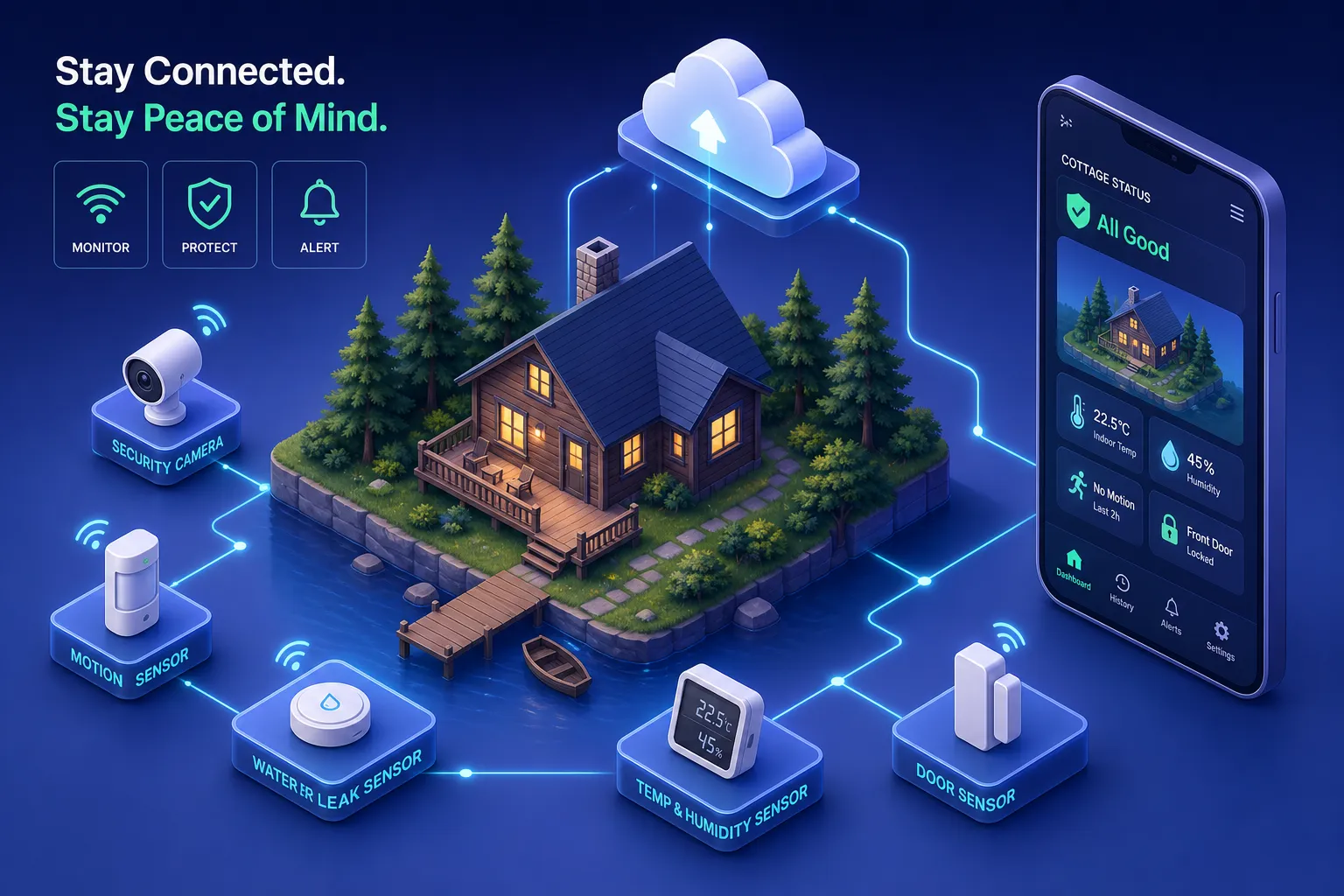

Remote cottage monitoring starts with knowing your greatest risks, and for most Ontario property owners, those risks are invisible until they become expensive. Picture this: it's January, the temperature outside your cottage has dropped to -25°C overnight, and you're sitting at home in Ottawa with no idea what's happening at the property. The pipes under the utility room run close to an exterior wall. You didn't get to check the heat tape last fall. Your closest neighbor is seasonal and hasn't been up since November. That specific anxiety is what drives most cottage owners to look into remote cottage monitoring, and it is completely justified. Insurance industry data consistently puts burst pipes at the top of off-season claims in Ontario, and they frequently occur while the property is unoccupied.
The challenge is that many consumer smart-home guides assume persistent home internet and regular occupancy, assumptions that break down entirely for a seasonal cottage. A seasonal cottage on Big Rideau Lake may sit vacant for months, lose power in storms, sit behind weak cellular signal, and face freeze-thaw cycles that would stress any structure. Getting remote cottage monitoring right means solving a different set of problems than securing a city home. This guide covers the full picture: the sensors you actually need, how to power and connect them without Wi-Fi, which cellular cottage monitoring systems work in Canada, and where a local caretaking service fills the gaps that no sensor can cover on its own.
Why monitoring a remote cottage is a different challenge
The risks that pile up when no one's checking
Seasonal cottage properties face four major threat categories that rarely apply to occupied urban homes. Freeze and pipe burst damage tops the list in Eastern Ontario, where the freeze-thaw cycle swings hard from November through March and a single overnight temperature drop can split a copper pipe in an unheated utility room. Water intrusion from storms or a failed sump pump is the second category: water that enters a basement or crawlspace undetected can cause mold, rot, and structural damage over weeks. Power outages are the third risk, not just because the lights go out, but because loss of power disables heat tape, sump pumps, and refrigerators, triggering a cascade of secondary damage.
Unauthorized entry during long vacant periods is the fourth category, and a seasonal cottage with no signs of activity is a more attractive target than it might seem. What makes all these risks serious is not the events themselves but the time between when something goes wrong and when someone finds out. Leaks can remain undetected for days or weeks, allowing water damage to accumulate quietly. Vandalism in October may go unnoticed until the May long weekend. That delay is what turns a manageable problem into a costly one, and a remote cottage monitoring system's job is to collapse it.
What standard smart home systems miss at the cottage
Many consumer smart home systems, Ring and Nest among them, are designed for daily-occupied residences with stable internet, reliable power, and someone home to respond to alerts. At a seasonal cottage, every one of those baseline assumptions breaks down. Wi-Fi-dependent devices go offline the moment the router loses power or the internet subscription lapses. Many of these systems are Wi-Fi-first and lack built-in cellular connectivity as standard. A device that cannot communicate when the power goes out is precisely useless in the scenario you are trying to protect against. For a no-WiFi cottage monitoring setup to actually work, cellular has to be the primary channel from the start, not an afterthought.
Remote cottage monitoring: the sensors every property needs
Temperature, freeze, and water leak detection
Temperature sensors are the most critical single tool for an unheated or partially heated cottage. When choosing one, look for accuracy of ±1°F or better. General-purpose multi-sensors can drift by ±2 to 5°F, which matters when you are trying to catch a temperature drop before pipes freeze. Place sensors near exposed pipes, in the utility room, in any crawlspace with plumbing, and in the basement. Also confirm that the device is rated to operate at -30°C or lower, because an unheated cottage can get cold fast and a sensor that stops working in those conditions is worthless.
Pair temperature monitoring with water leak sensors placed under every sink, near the water heater, around the sump pump, and at the base of any appliance with a water line. The critical spec for a leak sensor is immediate alert delivery, not just data logging. You want to know about water presence within minutes, not find it in a daily summary.
Power outage and intrusion sensors
A power outage sensor monitors AC mains loss and sends an alert after a configurable delay. The non-negotiable spec here is battery backup: the sensor has to keep communicating after power drops, which is the exact moment it matters most. Look for a device that also reports power restoration, so you know when the grid comes back without having to call anyone.
For intrusion coverage, door and window contact sensors cover primary entry points. Add motion sensors for interior coverage in open-plan spaces. Prioritize fast, reliable alert delivery over complex feature sets. At a cottage, a simple signal that something is wrong is worth more than a detailed activity log reviewed after the fact.
Remote cottage monitoring: connectivity and power
Cellular vs. Wi-Fi: what actually works at a remote property
For most Canadian cottages, cellular connectivity is the only viable primary option. A Wi-Fi-dependent cabin monitoring system is only as reliable as the router powering it and the ISP connection keeping it live, both fragile assumptions at a property that may sit vacant for months. Cellular cottage monitoring operates directly on carrier networks, staying active during power outages (with battery backup on the device) and eliminating the dependency on a separate internet subscription entirely.
Before purchasing any cellular system, check carrier coverage at your specific property. In Eastern Ontario cottage country, Bell and Rogers are generally a good first check for rural coverage, with Telus as a strong alternative; that said, performance varies by shoreline and topography. The best carrier on the main road may not be the best carrier at your dock. Test with a phone before committing to any monitoring hardware that locks you into a specific network.
Solar and battery options for uninterrupted monitoring
For cottages where the main breaker gets shut off at closing, or properties with no seasonal power, solar-powered monitoring is the practical answer. A basic setup includes a small solar panel, a lithium battery bank, and a charge controller. A Victron SmartShunt paired with an MPPT charge controller gives you accurate state-of-charge data and protects the battery from deep discharge, which is the main cause of early battery failure in off-grid setups.
Many cellular monitoring devices and LTE cameras draw low enough power to run from a modest solar array when the system is correctly sized. The key is calculating your actual daily load before choosing panel and battery capacity, rather than guessing and hoping the system keeps up through a stretch of cloudy days in November. Size conservatively and account for shorter winter daylight hours specific to Eastern Ontario.
The best cellular monitoring systems for Canadian cottages
Environmental monitoring: CabinPulse and similar systems
CabinPulse is a purpose-built option well-suited to Canadian cottage conditions. It monitors temperature, humidity, air quality, and power outage with built-in cellular connectivity, and it supports Bell, Rogers, Telus, Videotron, and SaskTel without requiring a separate data plan. It is designed specifically for remote cabin monitoring without Wi-Fi and is built to handle Canadian winter conditions. For cottage owners whose primary concerns are freeze damage, sump pump failure, and power loss, this is a direct solution that does not require assembling a system from scratch.
LTE cameras for video and perimeter coverage
For video monitoring without Wi-Fi, the practical category is LTE cameras. Vosker is widely used for remote and off-grid sites, with solar support and event-based recording suited for long-term outdoor deployment in rugged conditions. Reolink TrackMix LTE and Eufy 4G LTE Cam S330 offer higher video quality and broader coverage, useful for driveways, docks, and outbuildings. Arlo Go 2 is a cellular camera with straightforward setup and simple app access, a reasonable starting point for owners new to remote property surveillance.
On cost: expect to pay $25 to $45 CAD per month for a managed cellular monitoring plan, or $15 to $25 per month for a basic cellular data connection for environmental sensors alone. Equipment runs $200 to $600 upfront for a DIY setup.
DIY monitoring vs. professional managed services: real costs and tradeoffs
What DIY cottage monitoring actually costs and delivers
A DIY setup using a cellular environmental monitor plus one or two LTE cameras runs roughly $200 to $600 in upfront equipment, plus $15 to $30 per month in cellular fees. The limitation is not the equipment itself, it is the response layer. If you receive a freeze alert at 2 a.m. while traveling, you are the entire response chain. You call a local contact, coordinate access, and direct repair work from a distance. That works if you already have a trusted neighbor or caretaker in place. Without one, the alert tells you something is wrong but does not get anything resolved.
DIY monitoring is a strong choice when paired with a reliable local contact who can act on alerts. Add one supporting sentence to complete the thought: without that contact, even the best vacation home monitoring setup is an early warning system with no guaranteed follow-through.
When professional monitoring earns its cost
Professional monitoring services add a 24/7 dispatch layer that acts regardless of your availability. These services typically cost $25 to $50 CAD per month, with equipment and professional installation adding $1,000 to $1,500 upfront for a complete cottage security system. The financial case improves with home insurance: many Canadian insurers commonly offer roughly 5 to 20% off premiums for professionally monitored properties, with many examples centering around 10 to 15%. For a cottage insured at $200,000 or more, that discount can offset a meaningful portion of the annual monitoring fee.
The more important case is risk. An automated system that reaches a local responder when you cannot is a genuinely different level of protection than a personal alert on your phone at midnight. For cottage owners who travel, work long hours, or own properties more than a couple of hours away, that difference matters.
When technology needs a human backup
What sensors genuinely can't catch
Sensors detect conditions: temperature drops, water presence, motion, loss of power. They do not assess damage, document the state of a property for insurance, identify where a problem originated, or coordinate a contractor. A freeze sensor tells you the temperature dropped below threshold. It does not tell you whether a pipe has already burst or where the water has gone, and it certainly cannot tell you which local plumber to call on a Saturday in February. That gap is where a local caretaker becomes the most important part of a complete remote cottage monitoring plan: not a replacement for technology, but the layer that turns an alert into a resolved problem.
Photo-documented inspection reports also serve a purpose that sensors cannot: they create a timestamped record of the property's condition before and after an event, which is the most effective tool available when filing an insurance claim for storm or freeze damage. Insurers respond better to a professional inspection report with photographs than to an owner's description of what they found three weeks after the storm.
How Cottage Concierge supports Big Rideau Lake properties hands-on
Scheduled in-person property check-ins with detailed, photo-documented reports delivered by email after every visit. Every walkthrough includes documentation of any issues found and direct coordination with vetted local tradespeople when a repair is needed. Staff are background-checked and the business carries full insurance coverage, which matters when you are authorizing someone to access a property you have not visited in months.
The service covers cottage properties, which is a specific logistical advantage in this part of Eastern Ontario where sensor alerts alone cannot translate into boots on the ground without a local contact who knows the water. Annual retainer plans start at $1,500 per year and include priority emergency response. For owners running cellular monitoring technology alongside professional caretaking, the two layers work in direct combination: one catches the signal, the other resolves the problem. Visit cottageconcierge.ca to book a free 30-minute property walkthrough consultation and see whether the service fits your property's specific needs.
Putting the full picture together
Remote cottage monitoring is not a single product decision. It is a layered strategy built in the right order. Start with the sensors your property's specific risk points require: temperature and freeze detection first, water leak sensors second, power outage and intrusion coverage third. Then solve the connectivity and power problem before selecting any platform, because a sensor that goes offline in a January storm is worse than no sensor at all. Choose a cellular system suited to your property's environment and carrier coverage, and size any solar or battery backup to your actual load.
Once the technology layer is in place, decide honestly whether your response capability matches the alerts the system will generate. For Big Rideau Lake owners especially, cellular sensors and cameras handle the 24/7 data collection, and a local caretaking service like Cottage Concierge handles the physical response and documentation when something needs human attention. Many owners find the combined cost of remote cottage monitoring plus professional caretaking compares favorably to the repair bills a single undetected freeze event can generate, and no single tool comes close to matching what the full stack protects.